Saturday, June 30, 2007

Human History in Western Europe Extends to One Million Years Ago

This pre-molar is the oldest evidence of human occupation in western Europe.
Image: AFP


The Atapuerca site in northern Spain's Burgos Province has yielded the oldest human fossil in western Europe, extending the known human occupation in that region hundreds of thousands of years. Scientists had previously found fossil remains of humans at Atapuerca dating back 800,000 years, finds ascribed to Homo antecessor ("Pioneer Man"), but this recently unearthed pre-molar is the oldest, possibly an ancestor of Homo antecessor.

Labels: , , ,

Saturday, March 10, 2007

Romans in China?

Possible route of Roman legionnaires to China.
Image: Telegraph.co.uk

Liqian, a remote settlement on the edge of the Gobi desert in northwestern China, may be an unusual place to expect the birth of a blonde-haired baby girl. But that's how Gu Meina was born. Her father, Gu Jianming, says she is called "yellow hair" by her classmates at school. Another resident of Liqian, Cai Junnian, has been nicknamed "Cai Luoma," or "Cai the Roman," on account of his ruddy complexion and green eyes.

Homer Dubs, professor of Chinese history at Oxford in the 1950s, hypothesized that Liqian was founded by Roman legionnaires in the late first century BC. In 53 BC, Marcus Crassus' army was defeated in Mesopotamia by the Parthian Empire at the battle of Carrhae. Stories were told of scores of captive Roman warriors who wandered eastward. And seventeen years later, Chinese warriors talked of capturing soldiers who made a "fish-scale formation," perhaps a reference to the tortoise formation of the Roman legion.

Geneticists have taken blood samples from 93 Liqians, and results are pending.

Labels: ,

Tuesday, February 13, 2007

Stone Age Embrace

The late Stone Age pair was buried between 5,000 and 6,000 years ago.
Image: AP


Archaeologists in Italy have uncovered an embrace lasting over seventy centuries. The pair, discovered 25 miles south of Verona outside of Mantua, appears to be that of lovers buried together during the Neolithic period. Dental analysis shows that the couple was young at the time of burial. Although there is no concrete explanation for the pairing, many think the wife was sacrificed at the death of her husband. The area has provided many Neolithic finds, including thirty burials, as well as artifacts of pottery, flint and animal horns.


Labels: , ,

Sunday, October 01, 2006

Searching for the First Britons

A stone hand axe from Britain, credited to Neanderthal workers.
Image: BBC.co.uk


The second phase of the Ancient Human Occupation of Britain project has secured funds to begin. The project's first phase pushed human occupation of the island back 200,000 years, and scientists hope the next phase may yield further clues. Multiple species of humans have occupied Britain, including Homo heidelbergensis, Neanderthal man, and, of course, anatomically modern humans. Migrations occured over several hundred thousand years from the continent. The earliest site thus discovered is at Pakefield on the east coast of Britain, dating to some 700,000 years before present.

Labels: , , , ,

Friday, September 15, 2006

Writing in Mexico, 900 BC

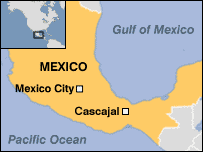
The slab was found in Cascajal, Mexico.
Image: BBC.co.uk


A recent discovery in Mexico reveals the characters of a writing system nearly three-thousand years ago. The discovery, a stone slab, contains 62 symbols, interpreted by archaeologists to be a written language. The writing is credited to the Olmec civilization, known best for their large head statues. The text is currently indecipherable, but archaeologists are hoping that future finds may provide clues. The findings are published in the journal Science.

Labels: ,

Thursday, September 14, 2006

The Last Neanderthals

Neanderthal Man: Eurasian Hominid
(c. 230,000-30,000/25,000 BP)
Image: BBC.co.uk
A study published in the journal Nature suggests the Neanderthals survived longer than previously thought. A find in Gorham's Cave on Gibraltar provides evidence of Neanderthal habitation until 24,000 years before present. They were previously believed to have gone extinct some 10,000 years prior. Professor Clive Finlayson stated that this find "shows conclusively that Gorham's Cave today was the last place on the planet where we know Neanderthals lived." The migration of modern humans into Eurasia and severe Ice Age climate change, among other causes, are believed to have led to the downfall of the Neanderthals.

Labels: , , , ,